+86-13989680588
 graylin@hongjiavalve.com
 Get a quote

 English
 русский
 Deutsch
Submit feedback
Why Heavy Duty Angle Valve Uses an Angle Design
Author: Hongjia
Date: Jul 24, 2026
Every time fluid changes direction inside a pipe, it pushes against the walls and creates turbulence. In a straight-through valve, the medium often gets forced through a convoluted path—down through the seat, across the cage, then up and out through the opposite side. Each turn costs energy and creates localized high-velocity zones where erosion takes hold. The angle valve takes a different approach. It uses the pipe's natural turn as part of the flow path, letting the medium enter from one direction and leave at a right angle without making extra detours along the way.
Picture what happens when water or steam hits the seating surface straight on. The impact concentrates on a small area, gradually wearing away metal until the seal fails. With an angle valve, the fluid strikes the seat at a slant. That oblique contact spreads the force over a broader region, so no single spot bears the full brunt of the flow. Over months and years of service, this difference translates into noticeably longer trim life, especially in systems where sand, catalyst fines, or other solids ride along with the process stream.
| Operational Characteristic | Straight-Through Valve | Angle Valve |
|---|---|---|
| Primary flow direction changes | Multiple (2-3 shifts) | Single 90-degree turn |
| Erosive impact on seat | Direct, concentrated | Oblique, distributed |
| Cavitation tendency in liquid service | Higher near seat | Lower due to gradual expansion |
| Pressure drop contribution | Moderate to high | Lower for same flow coefficient |
| Suitability for viscous fluids | Requires larger ports | Natural drainage aids flow |
Cavitation deserves special attention for anyone who has heard the telltale rattling sound coming from a valve handling liquid under high differential pressure. That noise means bubbles are forming and collapsing with enough force to pit metal surfaces. In an angle valve, the flow passage expands more gradually after passing the seat, allowing pressure to recover in a controlled manner. The bubbles collapse farther downstream, away from the critical sealing faces. This simple geometric advantage keeps valves in service longer and reduces the frequency of costly repairs.
Steam systems present another set of challenges, particularly during startup when condensate mixes with vapor. The angle shape handles this two-phase condition without the instability that plagues other designs. Gravity does its part—liquid tends to hug the bottom of the passage while vapor rises. The valve operates smoothly regardless of the steam quality entering the pipe.
Structural Integrity and Mechanical Advantage
Pressure pushes outward in all directions inside a closed vessel. The walls containing that pressure must resist hoop stress and longitudinal stress without yielding or cracking. Valve bodies with complex internal shapes often develop stress concentrations at sharp corners, exactly where the flow changes direction. The angle valve's pressure envelope follows a smoother contour. Instead of abrupt transitions, the metal curves gently from the inlet to the outlet, spreading the load across a wider area.
Piping systems never sit perfectly still. Thermal expansion pulls and pushes on every joint and fitting. Heavy schedule pipes weigh thousands of pounds, and their weight transfers bending moments into connected equipment. The angle valve, with its natural triangular bracing, withstands these external forces better than many alternatives. It functions almost like a structural member in the piping system, helping to anchor and support the surrounding runs.
Consider what happens to the valve stem during operation. As the disc travels toward the closed position, flowing medium pushes sideways against it. In a straight-through valve, that side load can deflect the stem, causing uneven wear on packing and making the valve harder to operate over time. The angle arrangement aligns the stem more closely with the seating direction, so the side force remains minimal. Less deflection means smoother operation, longer packing life, and fewer fugitive emissions along the stem seal.
Heat introduces its own set of complications. Metal expands as temperature rises, and different parts of a valve heat up at different rates. The bonnet warms more slowly than the body because it sits farther from the hot flowing medium. These temperature differences create differential expansion that can bind moving parts. The angle body's symmetrical design promotes even heating, with all sections seeing similar temperature profiles. Bolted joints stay tight, and the disc continues to move freely through its full stroke.
Maintenance and Accessibility Factors
Ask any maintenance supervisor about their preferred valve design for critical services, and the conversation often turns to accessibility. No one enjoys wrestling with equipment in cramped spaces, especially when every hour of downtime costs production revenue. The Heavy Duty Angle Valve earns appreciation in this regard through several practical features that stem directly from its geometric configuration.
The top-entry bonnet makes a real difference when repair time arrives. With the bonnet unbolted and lifted off, the entire internal assembly sits exposed. The seat ring, the disc, the stem, and the packing are all right there, reachable without dismantling the pipe connections.
Some valve designs force maintenance crews to extract internals through the ends of the body. That approach means cutting the valve out of the line, moving it to a workshop, and re-installing it after repairs. In contrast, many angle valves allow seat ring replacement while the body stays bolted in place between flanges. Special tools reach down through the bonnet opening to engage the seat, and with a few turns, the worn component comes free. The new seat goes in, the bonnet goes back on, and the system returns to service in a fraction of the time.
The orientation options add practical value. Mount the valve with the inlet pointing down and the outlet horizontal, and it drains completely when pressure is released. No pockets of corrosive or hazardous fluid remain trapped inside to endanger workers during maintenance. Turn it around with the inlet horizontal and the outlet pointing downward, and it serves as an ideal take-off point for routing flow to lower elevations. These simple installation choices give piping designers flexibility that straight-through valves cannot match.
Space constraints in older plants often force creative solutions. Piping runs through tight corridors, between vessels, and around structural columns. A straight-through valve demands a certain length of pipe before and after its location to settle flow disturbances. The angle valve combines the function of a directional change with flow control, eliminating the need for a separate elbow or tee fitting. That single substitution can save several feet of pipe run in congested areas.
Material and Manufacturing Considerations
Walk through the foundry where these bodies take shape, and the angle form reveals its manufacturing advantages right away. Pattern makers appreciate the geometry because it simplifies their work. The 90-degree turn allows for a straightforward parting line, meaning the mold halves come apart cleanly without complex core arrangements. Fewer cores mean fewer opportunities for shift or misalignment during metal pouring. Castings emerge with consistent wall sections and fewer defects to repair, a result that any experienced Angle Valve Factory strives to achieve with each production run.
Foundry workers know that thin sections cool faster than thick ones, and uneven cooling creates internal stresses that can warp or crack a casting. The angle body maintains relatively uniform cross-sections, so the metal solidifies at a predictable rate. This consistency reduces the need for extensive risering, keeping production costs manageable while delivering sound castings that pass radiographic inspection on the first attempt.
For high-pressure services demanding forged bodies, the angle shape offers additional benefits. During forging, metal flows along paths that follow the final contour. This flow pattern aligns the grain structure with the pressure boundary, so the internal fibers run parallel to major stress lines. A forging with this grain orientation resists pressure-induced failure more effectively, saving weight and cost.
Machining proceeds efficiently because the geometry lends itself to stable fixturing. Setup technicians mount the body with the bonnet flange facing up, and the two end connections oriented for easy access. Boring bars reach straight through to finish the seat area, while facing heads clean the flange surfaces in a single pass. Standard cutting tools do the work without special custom tooling, keeping setup times reasonable in a typical Angle Valve Factory.
| Manufacturing Aspect | Impact on Production |
|---|---|
| Pattern design | Straightforward parting line, fewer cores |
| Solidification | Uniform wall sections, predictable cooling |
| Forging grain flow | Follows pressure boundary contours |
| Machining setup | Stable orientation for flange and seat work |
| Inspection | Accessible surfaces for testing |
Quality control personnel carry out inspections with similar ease. Radiography requires clear visibility through the walls, and the angle body's consistent thickness allows for reliable interpretation. Ultrasonic transducers couple well to external surfaces, and the simple internal geometry means any indications show up clearly. Dye penetrant checks reach all accessible surfaces without difficulty.
Material selection for demanding services often involves corrosion-resistant alloys. Nickel-based grades, duplex stainless steels, and titanium all find their way into production. The geometry accommodates these materials without requiring extreme thickness variations that might complicate welding. When hardfacing gets applied to seating surfaces, the accessible angle configuration allows for consistent deposition and finishing.
Applications and Installation Considerations
Field experience shows where the angle configuration delivers its greatest value.
Boiler feedwater systems benefit from the gradual pressure recovery, which reduces cavitation risk. The oblique seating arrangement keeps erosion in check despite high velocity through the restricted opening.
Slurry pipelines favor the angle design because the flow path encourages solids to stay in suspension. The 90-degree turn creates a sweeping action that carries particles through without letting them accumulate in deadlegs.
Steam services handle wet steam without the water hammer or chatter that damages other designs. Natural stratification of liquid and vapor inside the body means the valve responds smoothly to control signals.
High-pressure letdown stations often pack multiple valves into tight spaces. The angle valve's compact footprint allows designers to arrange units in a smaller area, keeping the entire station within a reasonable envelope.
Chemical reactor feed systems handling corrosive fluids benefit from the linear flow characteristic needed for stable control loop performance. Maintenance crews service the valve without breaking the bottom flange connection—a significant advantage when piping contains hazardous chemicals.
Operational Reliability Over Extended Service
Valves in heavy service cycle between open and closed positions, endure pressure fluctuations, and contend with temperature swings. Yet the angle configuration demonstrates staying power that keeps plants running between scheduled turnarounds.
Packing performance plays a larger role in reliability than many realize. The angle valve's reduced stem side loading means the packing gland experiences less uneven pressure. With packing compressed uniformly around the stem circumference, seal integrity holds longer. Operators adjust packing less frequently.
The seat and disc arrangement provides a self-cleaning action. When the valve closes, the disc sweeps across the seat face, wiping away deposits that might otherwise accumulate. This wiping motion keeps sealing surfaces clean in services where polymerization or deposition occurs.
Threaded connections and bolted joints remain tight because the body geometry distributes piping loads evenly. Flange faces stay aligned, and gaskets maintain their seal without uneven compression. This mechanical stability matters particularly in outdoor installations where wind loading, vibration, and thermal cycling act on connected piping.
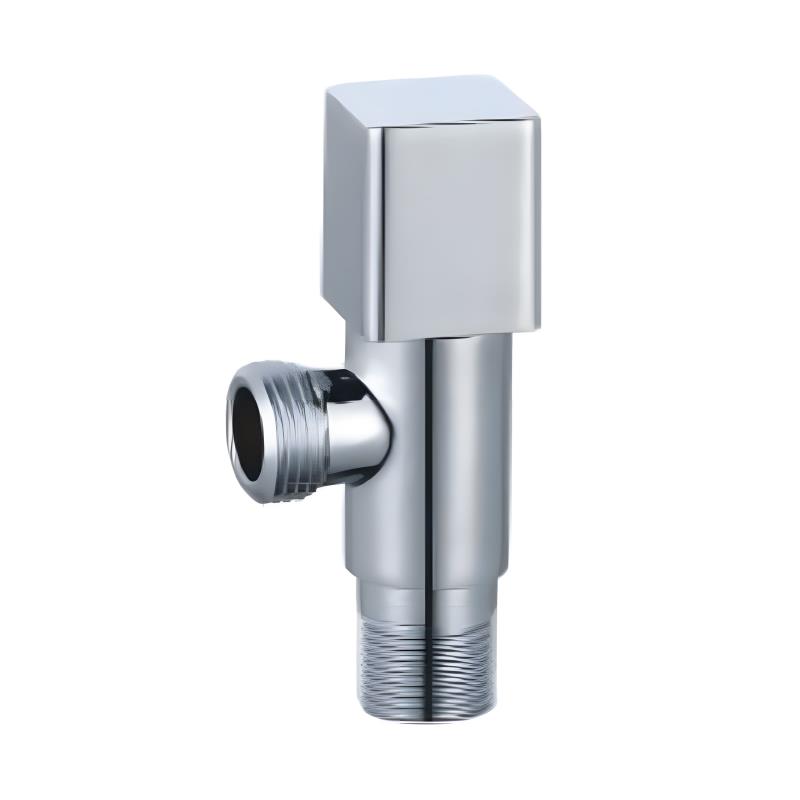
Why the Angle Continues to Find New Applications
New processes and emerging industries continue to adopt the angle valve configuration. Renewable energy facilities, carbon capture installations, and advanced chemical plants all face similar challenges of high pressure, temperature extremes, and corrosive media. The engineering principles that made the angle shape practical decades ago remain equally valid today.
Operators and engineers who specify valves for new projects often draw on years of field experience. Their preference for the angle configuration in tough services reflects practical observation, not marketing influence. When a valve design keeps performing year after year, through startup and shutdown cycles, through full-load operation and partial-load turndown, that record carries weight.
The angle shape endures because it solves real problems in real plants. From flow dynamics that protect seating surfaces to mechanical design that handles piping loads, from maintenance access that reduces downtime to manufacturing practicality that keeps costs reasonable, each aspect reinforces the others. Plants around the world continue to install these valves at pipe turns, trusting the geometry that has proven itself across generations. Some engineering solutions remain because they address fundamental needs effectively, and this configuration stands as one such example—simple in concept, consistent in execution, and reliable in practice.